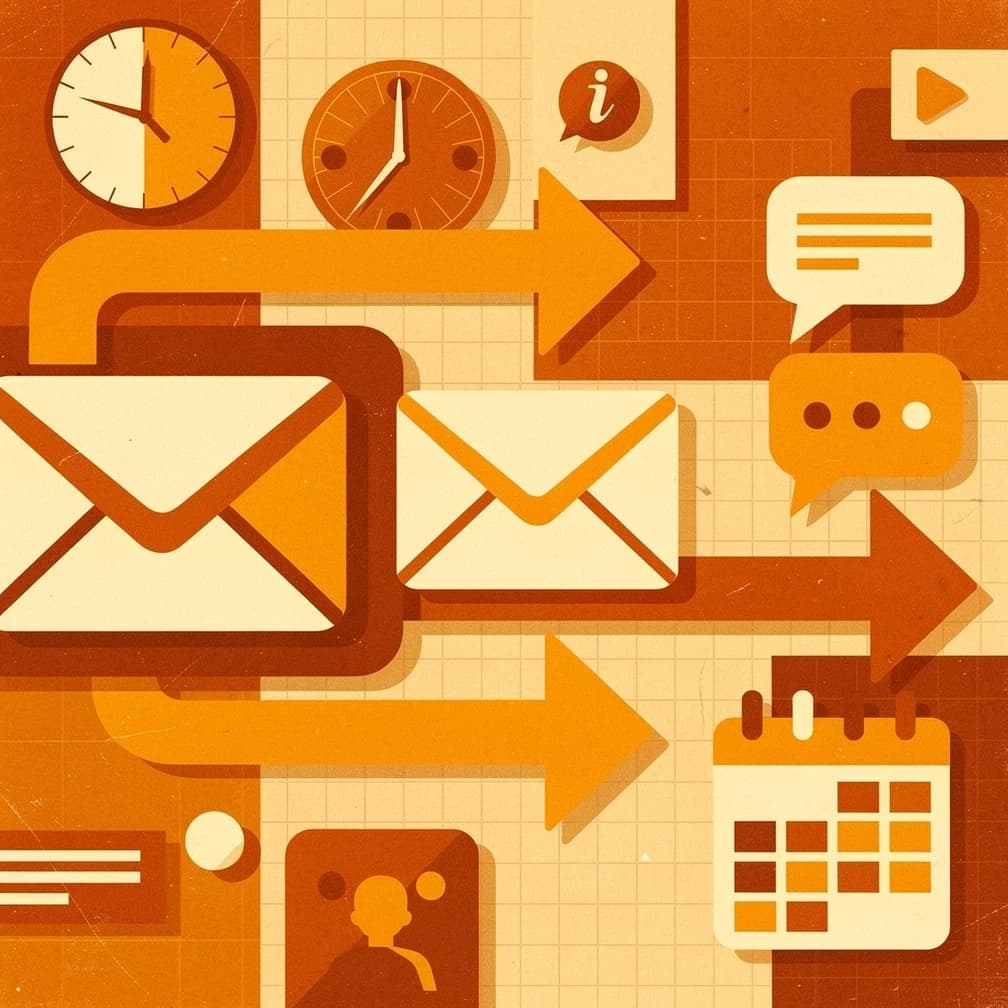
Most small business owners are still writing individual emails — one at a time, to one person at a time. That approach doesn't scale, and it means your follow-up quality depends entirely on how much time you have on any given day. Email automation fixes that. Pre-written sequences trigger automatically based on what contacts do (or don't do), so your best follow-up goes out at exactly the right moment without anyone on your team lifting a finger.
The good news for Australian SMBs is that the tools have become genuinely accessible. You can start for free, get your first automation live in an afternoon, and see measurable results within weeks — not months. This guide covers what to build first, which tools to use, and how to get set up within 48 hours.
Key Takeaways
- Automated emails generate 320% more revenue per send than broadcast emails, according to Campaign Monitor research
- The five highest-ROI automations for SMBs are: welcome series, lead nurture, post-purchase, re-engagement, and abandoned cart
- Most small businesses can get their first email automation running in under 48 hours for $0–$29/month
- Segmented automated campaigns have 14.31% higher open rates than unsegmented sends, per HubSpot data
- Start with a 3-email welcome series — it consistently delivers the fastest ROI of any automation type
Why Email Automation Delivers the Highest ROI of Any Channel
According to DMA research, email marketing returns an average of $42 for every $1 spent — and that figure climbs significantly when automation is involved. Campaign Monitor's analysis of over 30 billion emails found that automated campaigns generate 320% more revenue per email compared to one-off broadcast sends. For Australian SMBs running lean teams, the maths is straightforward: one hour setting up an automation today saves dozens of hours of manual follow-up over the next twelve months.
The reason automation outperforms manual email comes down to timing. An automated welcome email sent within five minutes of a sign-up gets a 4x higher open rate than one sent hours later, according to GetResponse benchmark data. Most small businesses can't respond that fast manually. An automation can, every single time, whether it's 2pm on a Tuesday or 11pm on a Sunday.
Australian businesses are catching on. A 2025 Deloitte Access Economics survey found that SMBs adopting marketing automation reported 23% higher customer retention rates compared to businesses relying solely on manual outreach. The gap between businesses that automate and those that don't is widening every year.
The 5 Email Sequences Worth Automating First
The highest-ROI email automations for small businesses handle predictable moments in the customer lifecycle. Build these five sequences and you've covered 80% of your automation needs.
1. Welcome series (3 emails over 7 days)
Triggered when someone subscribes to your list. Email 1 delivers the lead magnet or confirms the sign-up and sets expectations. Email 2 shares your story and one genuinely useful tip. Email 3 makes a soft offer or invites a conversation. Welcome sequences average 50–60% open rates — two to three times the industry standard for regular newsletters. This is the single most valuable automation any SMB can build.
2. Lead nurture sequence (5–7 emails over 3–4 weeks)
For prospects who've shown interest but haven't bought. Share educational content, address common objections, and build trust before asking for the sale. According to HubSpot's State of Marketing report, nurtured leads make 47% larger purchases than non-nurtured leads — a meaningful difference for any service business with a high average transaction value.
3. Post-purchase onboarding (3–5 emails over 2 weeks)
Triggered after a sale completes. Guides new customers through getting started, shares tips for extracting the most value, and asks for a review at the moment they're most likely to leave one. Good onboarding automation reduces refund rates and increases repeat purchase frequency.
4. Re-engagement campaign (2–3 emails over 2 weeks)
For subscribers or customers who've gone quiet — typically no opens or clicks in 90+ days. A well-crafted re-engagement sequence recovers 10–25% of dormant contacts at zero additional acquisition cost. The alternative is emailing an unengaged list that hurts your sender reputation and deliverability for everyone else.
5. Abandoned cart recovery (2–3 emails over 48 hours)
If you sell products or services online, abandoned cart emails are the closest thing to free money in email marketing. According to Klaviyo's benchmark report, abandoned cart sequences recover an average of 5–10% of abandoned purchases, with top-performing setups reaching 15–20%.
For businesses also running broader marketing automation across SMS, social retargeting, and paid channels, the marketing automation for small business overview covers how email fits into that wider stack.
Pro tip
Pro tip: Build your welcome series before any other automation. It fires at the moment of highest intent — when someone just opted in — and it sets the tone for your entire email relationship. Businesses that build a welcome series first typically see their list generate 30–40% more revenue within 90 days compared to those that start with more complex sequences.
Email Automation Tools Compared for Australian SMBs
The best email automation tool for a small business is the one your team will actually use consistently. Here's how the main platforms compare on the criteria that matter most for SMBs.
| Tool | Starting Price | Best For | Free Tier | Key Strength |
|---|---|---|---|---|
| Mailchimp | $0–$13/month | Early-stage, simple automations | Yes (500 contacts) | Easiest onboarding |
| ActiveCampaign | $29/month | Service businesses, complex sequences | No (14-day trial) | Strongest automation builder |
| Klaviyo | $45/month | E-commerce, product businesses | Yes (250 contacts) | Best e-commerce integrations |
| HubSpot | $0–$18/month | B2B, CRM + email combined | Yes (2,000 emails/day) | Best CRM integration |
| Drip | $39/month | E-commerce with custom workflows | No (14-day trial) | Detailed revenue attribution |
Mailchimp is the right starting point if you're new to email automation. The free tier covers most early-stage needs, the interface is intuitive, and basic automations like welcome emails and birthday sequences are genuinely straightforward to configure. The limitations show up as your list and workflow complexity grow.
ActiveCampaign is the tool most of our clients end up on once they move beyond the basics. Its visual automation builder lets you map out sequences based on actions, tags, and contact behaviour — including conditional branching (send Email B only if they opened Email A). For service businesses running complex nurture sequences, it's the most capable tool at this price point.
Klaviyo wins for product-based businesses and e-commerce. The Shopify and WooCommerce integrations are best-in-class, and the abandoned cart and post-purchase sequences are highly sophisticated out of the box. If you're not e-commerce, the price-to-value calculation is less compelling.
HubSpot's free tier combines a CRM with email marketing — if you're also tracking leads and deals, starting here means one less tool integration. The free plan is genuinely capable for basic automation, though advanced conditional branching and predictive features sit behind a paid plan.
What Business Owners Are Saying
The consistent feedback from small business operators is that the hardest part of email automation isn't the technology — it's writing the content. Setting up the tool takes an afternoon. Writing 7 emails for a nurture sequence tends to take three weeks because it keeps getting pushed to "when things slow down."
The practical fix most experienced operators recommend: write your first sequence in one sitting, even if it's rough. A mediocre automation that's live and sending beats a polished one sitting in drafts. Open rate and click data will tell you exactly which emails need rewriting, and you can improve them iteratively once they're running.
Service-based businesses also regularly note that the 3-email welcome series they expected to feel "too simple" consistently outperforms longer sequences. Fewer emails, each delivering clear value quickly, tends to convert better than trying to cover everything in one sprawling nurture campaign.
Pro tip
Common mistake: Choosing a platform based on its feature list rather than your actual starting workflow. Most small businesses need nothing more than a welcome series and one nurture sequence for the first six months. Start with the simplest tool that handles those two things well, then upgrade when you genuinely outgrow it. According to Gartner, businesses that over-invest in marketing technology upfront are 2x more likely to abandon the implementation entirely.
How to Set Up Your First Email Automation in 48 Hours
Setting up a basic 3-email welcome series takes most small businesses between 2 and 4 hours, not counting content writing. Here's the step-by-step:
Day 1 — Hour 1: Sign up for your chosen tool and connect it to your website, Shopify store, or lead magnet landing page. Mailchimp and HubSpot both have plug-and-play integrations that take 15 minutes for standard setups.
Day 1 — Hour 2: Write 3 welcome emails. Email 1: deliver the promised value (lead magnet download, subscription confirmation) and set expectations for what's coming. Email 2: share one genuinely useful tip or insight related to why they signed up. Email 3: make a single clear offer or invite a conversation — not both.
Day 1 — Hour 3: Build the automation in your tool. Set Email 1 to send immediately on sign-up. Email 2 at 2 days delay. Email 3 at 5 days delay. This is a standard welcome cadence that works across most industries. Activate a test by subscribing with a personal email address, verify the timing and formatting, then go live.
Day 2: Check your test inbox. Fix any formatting or link issues. Your automation is now running 24/7 for every new subscriber without any further effort from your team.
For connecting email automation to your broader CRM and sales pipeline — including how to pass hot leads automatically from email sequences into sales workflows — the AI workflow automation quick wins guide covers the integration layer in detail.
If you're building the funnel that feeds your email sequences (landing pages, lead magnets, paid ads), the AI lead generation for small business article walks through how to generate a consistent flow of subscribers worth automating.
For service businesses specifically, AI Sales Enablement services can help connect your email automation to a structured sales process so leads that engage with your sequences flow directly into your pipeline.
What Results to Expect and When
Email automation delivers measurable results quickly relative to most marketing investments. Here's a realistic timeline based on client experience:
- Week 1–2: Welcome series live, automatically sending to all new subscribers
- Month 1: Open rate, click rate, and unsubscribe data accumulating — enough to identify which emails are working
- Month 2: First optimisation pass — rewrite subject lines that underperform, cut emails nobody opens
- Month 3: ROI visible in revenue, reduced manual follow-up time, or both
HubSpot benchmark data shows that small businesses typically see a 15–30% reduction in manual sales follow-up time within 90 days of deploying a basic automation stack. At an average of 5–8 hours per week spent on manual email outreach, that's 50–125 hours reclaimed per year — at a tool cost of $0–$45/month.
For a rigorous breakdown of how to build the ROI business case for email and broader automation investments, the ROI of AI implementation for service businesses article walks through the same framework.
The AI Productivity Stack guide also covers how email automation fits into a broader AI-enabled workflow for small business teams, including the integrations that multiply its value.
For the technical side of how AI personalisation works within email tools, the team at AI Insights covers email AI personalisation models in depth. And for content strategy — what to actually write in your sequences to maximise conversion — Marketing Edge covers email content strategy with detailed frameworks.
Summary: Email Automation at a Glance
| Sequence | Trigger | No. of Emails | Typical Open Rate | Build Priority |
|---|---|---|---|---|
| Welcome series | New subscriber sign-up | 3 (over 7 days) | 50–60% | #1 — build first |
| Lead nurture | Lead magnet download | 5–7 (over 3–4 weeks) | 25–35% | #2 |
| Post-purchase onboarding | Order or contract confirmed | 3–5 (over 2 weeks) | 40–50% | #3 |
| Re-engagement | 90 days inactive | 2–3 (over 2 weeks) | 15–25% | #4 |
| Abandoned cart | Cart not completed | 2–3 (over 48 hours) | 35–45% | #5 (e-commerce) |
Where to Start
If you currently have zero email automations running, start with a welcome series this week. Sign up for Mailchimp (free), write 3 emails in one sitting, set the send delays, and activate. Two to four hours of upfront work, and you have an automation running around the clock.
From there, add the lead nurture sequence in month two and a re-engagement campaign in month three. That's a complete automation stack for most Australian SMBs — and it runs for under $30/month once you're on a paid plan.
If you're unsure which sequences to prioritise for your specific business model — whether you're a service firm, retail operator, trades business, or professional services practice — that's the kind of diagnostic we work through regularly at GrowthGear. We help clients map their customer journey, identify the highest-ROI automation opportunities, and build sequences that actually convert. If you'd like experienced eyes on your setup, that's one of our core services.
Once you have your automation foundation in place, the next step is layering AI-powered personalisation — where the platform decides who gets which email based on their behaviour, not fixed rules you've defined. Our AI email marketing tools guide covers the best platforms for moving from basic sequences to predictive, behaviour-driven email marketing in Australian SMBs.
Frequently Asked Questions
Email automation sends pre-written emails to contacts automatically based on triggers — like signing up, making a purchase, or going inactive. Small businesses use it to nurture leads, onboard customers, and follow up without manual effort, typically using tools like Mailchimp, ActiveCampaign, or HubSpot starting from $0/month.
Basic email automation starts at $0 with Mailchimp's free tier (up to 500 contacts). Most small businesses pay $13–$45/month for tools with more advanced features. According to DMA research, email returns $42 for every $1 spent — making it one of the highest-ROI marketing channels available to SMBs.
For most Australian SMBs, Mailchimp is the best starting point — it's free, easy to use, and covers basic automations well. ActiveCampaign ($29/month) suits service businesses needing complex sequences. Klaviyo ($45/month) leads for e-commerce. HubSpot's free tier is best if you need email combined with CRM.
Most small businesses can set up a basic 3-email welcome series in 2–4 hours, including writing the emails. More complex sequences like a 7-email lead nurture take 4–8 hours total. The upfront investment typically pays back within the first month through saved manual follow-up time alone.
Start with a 3-email welcome series triggered on new subscriber sign-up. It consistently delivers the fastest ROI of any automation type, with open rates of 50–60%. Add a lead nurture sequence second and a re-engagement campaign third. These three automations cover the most impactful moments in the customer lifecycle for most businesses. For a complete framework for the nurture sequence specifically — including a 5-email structure, lead scoring setup, and benchmarks — see our automated lead nurturing for small business guide.
Yes — service businesses typically see some of the strongest results from email automation. Welcome and lead nurture sequences are highly effective for consultants, agencies, trades operators, and professional services firms. According to HubSpot, nurtured leads make 47% larger purchases, which has a significant impact on revenue in high-value service contexts.
Track open rate (industry average 20–25%), click rate (2–5%), and conversion rate (1–3%) per sequence. Also track time saved on manual follow-up and revenue attributed to automated sends. Most platforms provide this data in their analytics dashboard. Review and optimise each sequence every 90 days.
Sources & References
- DMA Research — "Email marketing delivers an average ROI of $42 for every $1 spent" (2019)
- Campaign Monitor Email Marketing Benchmarks — "Automated emails generate 320% more revenue per email than non-automated broadcast sends" (2024)
- GetResponse Email Marketing Benchmarks — "Welcome emails achieve 50–60% open rates, 2–3x higher than regular campaigns" (2025)
- HubSpot State of Marketing Report — "Nurtured leads make 47% larger purchases; segmented campaigns have 14.31% higher open rates" (2025)
- Klaviyo E-commerce Benchmarks — "Abandoned cart email sequences recover 5–15% of abandoned purchases on average" (2025)