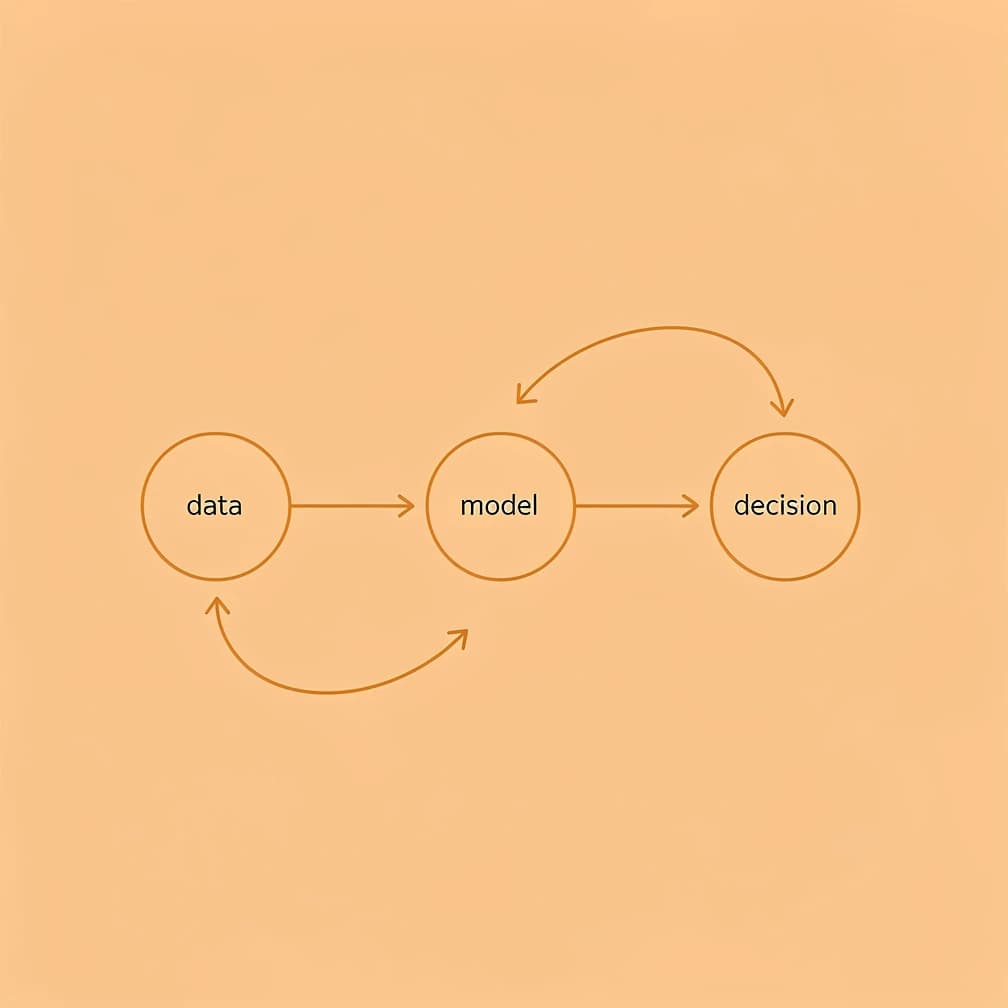
Most small business owners who say "we should do a machine learning project" picture a six-month research effort run by data scientists they cannot hire. In 2026 that is the wrong mental model. A modern small business ML project is a delivery project with a model in the middle — closer in shape to rolling out a CRM than to writing a research paper. According to McKinsey's 2024 State of AI report, 72% of organisations now use AI in at least one function, with most value coming from operational ML that ships in weeks, not quarters.
This is the playbook we walk Australian SMB clients through — what an ML project is, when to start, the stages, the tools, realistic cost and timeline, and why most first projects fail. If you don't yet know what ML is broadly, start with our machine learning for small business primer.
Key Takeaways
- A small business ML project is the end-to-end work of picking a decision worth predicting, cleaning the historical data, training and validating a model, and embedding its output into a workflow someone owns.
- According to Deloitte's 2025 State of AI in the Enterprise survey, organisations shipping ML in under 90 days are 2.5x more likely to report positive year-one ROI than those running pilots longer than six months.
- A realistic first ML project for an Australian SMB costs AUD $0–$8,000 all-in, takes 6–12 weeks from kickoff to first decision, and uses tools you already pay for (Shopify, HubSpot, Xero, Klaviyo) plus at most one AutoML add-on.
- The two highest-payoff first projects are demand forecasting (if you carry inventory) and churn prediction (if you bill recurring revenue) — both have clear dollar-per-decision economics and 12+ months of clean data in most SMBs.
- Most first ML projects fail for non-technical reasons: vague success metric, no action owner, or fewer than 1,000 historical examples — fix those before writing a line of model code.
What is a machine learning project for a small business?
A machine learning project for a small business is a time-boxed initiative that turns a recurring business decision into a model-driven prediction, with a clear owner, a measurable success metric, and a workflow that acts on the model's output. It is delivery work, not research — typically 6–12 weeks end-to-end. The deliverable is a live prediction wired into a tool the team already uses, not a model file.
This framing forces three commitments before any code is written: a single decision being predicted, a person accountable for that decision, and a baseline you can beat. Stanford HAI's 2024 AI Index notes that organisations capturing real ML value treat each model as a change-management project, not a software deliverable. Without those three commitments the model becomes shelfware. The wider strategy frame is in our AI implementation strategy guide.
When should a small business start its first ML project?
Start your first ML project when you have a recurring, high-stakes decision the business makes manually more than ~50 times per month, plus 12 months of clean historical data on the outcome. Before then, the project lacks enough signal to pay back; after then, every month of delay is roughly one month of revenue or cost the model would have improved.
The ABS Business Conditions and Sentiments data shows about 30% of Australian SMBs adopt some form of AI annually, concentrated in businesses already using cloud accounting and a CRM — both proxies for the structured data ML needs. The trigger usually appears between AUD $1M and $5M in revenue.
Three readiness signals: your team can name the top five decisions they make weekly without thinking; those decisions live inside a tool that exports cleanly (Xero, HubSpot, Shopify, Klaviyo, Cin7); and leadership can say in advance what success looks like in dollars. Two out of three is fine; zero means the next project should be operational tidy-up, not ML.
What are the stages of a small business ML project?
A small business ML project moves through six stages: scope, data, baseline, build, deploy, measure. Total elapsed time is 6–12 weeks; only stages four and five involve modelling, and they are the shortest. According to Gartner's 2025 Hype Cycle for AI, predictive ML projects almost always fail in stages one to three — which is why most of the playbook sits there.
| Stage | What happens | Typical time | Common failure mode |
|---|---|---|---|
| 1. Scope | Decide the decision, owner, metric, baseline | 3–5 days | Vague metric; no owner |
| 2. Data | Extract and clean 12+ months of history | 1–3 weeks | Under 1,000 examples; missing labels |
| 3. Baseline | Measure how the manual decision performs today | 2–5 days | No baseline; cannot prove improvement |
| 4. Build | Train one or two AutoML or embedded models | 3–7 days | Over-engineering; chasing 1% gains |
| 5. Deploy | Wire predictions into the team's existing tool | 3–10 days | Lives in a spreadsheet no one opens |
| 6. Measure | Compare model decisions vs baseline | 4–8 weeks | No cadence; project quietly dies |
Scope plus data routinely takes more than half of the project; skipping them is what kills first projects. The operational mechanics sit in our implementation playbook.
Pro tip
Pro tip: Write the deploy plan before you build the model. If you cannot describe in one sentence where the prediction will appear and who will act on it, do not start training. We routinely cut a week of build time by forcing this on day one of scope.
How do you choose the right machine learning project to start with?
Choose the first project with the cleanest data, the clearest dollar-per-decision economics, and the simplest deployment path — in that order. Most SMBs default to the most exciting use case (often generative chatbots), but the highest-ROI first projects are the boring predictive ones: demand forecasting, churn prediction, lead scoring, dynamic pricing, or invoice anomaly detection. Harvard Business Review research on AI value capture found predictive ML pays back fastest where it improves a high-frequency, high-stakes decision already made manually.
Pick the row that matches your business model:
| Business model | Recommended first project | Data needed | Year-one impact |
|---|---|---|---|
| Retail / ecommerce | Demand forecasting | 12 months of SKU sales | 18–32% fewer stockouts |
| Subscription / SaaS / gym | Churn prediction | 12 months customer activity | 1.5–4 pp retention lift |
| B2B services / outbound | Predictive lead scoring | 200+ closed-won deals | 20–35% revenue per rep |
| Multi-product retail | Dynamic pricing on top SKUs | 6 months pricing + sales | 3–8% margin lift |
| Any business with invoices | Invoice anomaly detection | 12 months transactions | 30–60% fewer fraud losses |
These dominate for one unglamorous reason: the data already exists in tools the business pays for, the decision happens often enough for a model to matter, and the dollar value is obvious. Our predictive analytics for small business guide breaks down the tool-by-tool implementation; for B2B lead scoring, the Sales Mastery pipeline coverage digs into the routing workflow that turns scores into booked meetings.
"Our first ML project was the third one we tried to scope. The first two had no clean data and no decision owner. Once we picked the boring churn one, it shipped in nine weeks and paid back in four." — Operations lead, Australian SaaS client (paraphrased with permission)
How much does a first machine learning project cost for an Australian SMB?
A first ML project for an Australian SMB typically costs AUD $0–$8,000 all-in for year one, depending on whether you use embedded ML or build a custom AutoML model. Software is rarely the binding constraint — the real cost is 30–80 hours of internal time across scoping, data clean-up, and change management. According to Deloitte Access Economics' Digital Pulse, only 27% of Australian small businesses had a dedicated data budget in 2024, yet 61% were running embedded ML through their SaaS stack — most first projects run on existing licences.
| Cost tier | What you pay for | Year-one total (AUD) | Internal hours |
|---|---|---|---|
| Embedded only | Existing Shopify, HubSpot, Xero, Klaviyo features | $0 in new software | 30–50 hours |
| Vertical add-on | One ML-specific tool (ChartMogul, Prisync, Cin7) | $600–$5,000 | 40–70 hours |
| Custom AutoML | Vertex AI or SageMaker Canvas, plus light consulting | $2,500–$8,000 | 60–120 hours |
The cost the spreadsheet usually misses is the cost of not doing it. On a 1,000-customer subscription book at AUD $80/month, every retention point lost while you delay is roughly AUD $9,600 of annual revenue. The broader investment maths sits in our ROI of AI implementation.
What tools should a small business use to run a machine learning project?
For a first project, use the tools you already pay for plus at most one specialist add-on. The Australian SMB stack already contains production-grade ML inside Shopify, HubSpot, Xero, Klaviyo, and Salesforce — most first projects ship without buying anything new. According to McKinsey, the strongest predictor of ML success is not vendor choice but whether the model output reaches a decision-maker inside a tool they already use daily.
| Use case | Built-in option (often free) | Specialist add-on (AUD/month) | AutoML option |
|---|---|---|---|
| Demand forecasting | Shopify Magic, Cin7 Core | Inventory Planner ($150–$500) | Vertex AI Forecast |
| Churn prediction | HubSpot predictive scoring | ChartMogul Retain ($100–$400) | SageMaker Canvas |
| Lead scoring | HubSpot Sales Hub, Salesforce Einstein | Apollo ($60–$200 per seat) | DataRobot AutoML |
| Dynamic pricing | Shopify Functions (basic) | Prisync ($100–$400) | Custom AutoML |
| Invoice anomalies | Xero analytics, Stripe Radar | MindBridge ($300+) | BigQuery ML |
The rule we apply with clients: never buy a specialist tool until you have proven the use case with the embedded one. The embedded model is often accurate enough; if not, you now know exactly what shortfall the new tool must fix. For tool comparisons see our AI tools for small business guide; for predictive-ML-specific tooling, the engineering coverage on ai.growthgear.com.au.
How long does a first machine learning project take from kickoff to value?
A well-scoped first ML project takes 6–12 weeks from kickoff to the first decision the model influences, plus 4–8 weeks before financial impact is clearly visible. Most elapsed time is data preparation and change management — actual training takes a few days. According to Deloitte, organisations shipping ML in under 90 days are 2.5x more likely to report positive year-one ROI than those running pilots longer than six months.
| Week | Stage | Visible deliverable |
|---|---|---|
| 1 | Scope | One-page brief with metric, owner, baseline |
| 2–4 | Data | Clean dataset with at least 1,000 examples |
| 5 | Baseline | Documented manual baseline performance |
| 6 | Build | First trained model with validation metrics |
| 7 | Build / review | Second model variant; pick the better one |
| 8 | Deploy | Live predictions inside the team's tool |
| 9–12 | Measure | Weekly model-vs-baseline review |
| 13–20 | Iterate | Retrain monthly; expand or kill the project |
If you are still in stage one or two at week six, the scope is wrong — not the team. Set a kill-or-ship gate at week eight: predictions are live in a real tool, or the project pauses for re-scope. The longer-form playbook sits in our AI implementation playbook.
Why do most small business machine learning projects fail?
Most SMB ML projects fail for non-technical reasons — vague metric, no action owner, dirty data, or no measurement cadence. Gartner attributes more than half of failed predictive AI deployments to operating-model gaps, not model accuracy. The model usually works; the workflow around it does not.
The five failure patterns we see most often, and the fix for each:
- Vague metric. "Improve churn" is not a metric. "Lift 90-day retention from 78% to 82% on customers with score > 70" is. Fix: write the metric in week one.
- No action owner. A churn score with no one calling at-risk customers is decoration. Fix: name one person whose job changes the day the model goes live.
- Too little or dirty data. Models need roughly 1,000 examples to learn a useful pattern. SMBs often start with 200. Fix: pick a project with more history, or wait.
- No baseline. Without a documented manual baseline you cannot prove the model improved anything. Fix: measure the current process for two weeks before training.
- No measurement cadence. Models drift; without weekly reviews the project quietly dies. Fix: a 30-minute weekly review for 90 days, then monthly.
Pro tip
Common mistake: Hiring or contracting a data scientist before you have answered the scope and data questions. We routinely see Australian SMBs spend AUD $20,000 on consulting only to find the underlying decision was never well defined. Spend the first week on scope, not on hiring.
Where should you start this week?
Start with a one-page brief, not a tool selection. Write five lines: the decision being predicted, the dollar value of getting it right, the action owner, the success metric, and the baseline. If you can answer all five honestly, you have a viable project. If you cannot answer two or more, the project is not scoped yet.
In week one, do four small things: pull the last 12 months of data into a spreadsheet, count whether you have at least 1,000 examples, ask the action owner what they would do differently if the model existed today, and book the first review for week nine. Together those take about three hours and remove most of the project risk.
If you'd rather have experienced eyes guide the scoping — especially the data audit and baseline — that is the kind of work we do at GrowthGear through our AI strategy and implementation service. Most of the value comes from week one, not the modelling weeks.
Summary: small business ML project at a glance
| Question | One-line answer |
|---|---|
| What is it? | A 6–12 week delivery project wiring a model into a recurring decision |
| When to start | 12 months of clean data on a recurring, high-stakes decision |
| Best first project | Demand forecasting (retail), churn (subscription), lead scoring (B2B) |
| Year-one cost | AUD $0–$8,000 all-in, plus 30–120 internal hours |
| Time to value | 6–12 weeks to first decision; 4–8 weeks more to measurable impact |
| Common failure | Vague metric or no action owner — both non-technical |
| This week | One-page brief: decision, dollar value, owner, metric, baseline |
Frequently Asked Questions
A machine learning project for a small business is a 6–12 week delivery project that turns a recurring business decision into a model-driven prediction with a single owner and a measurable success metric. The deliverable is a live prediction wired into a tool the team already uses, not a model file.
A first ML project for an Australian SMB typically costs AUD $0–$8,000 in software for year one, plus 30–120 internal hours. According to Deloitte, 61% of Australian small businesses already run embedded ML through tools they pay for, so most first projects need no new licences.
A well-scoped first project takes 6–12 weeks from kickoff to the first decision the model influences. Most of that time is scope, data prep, and deployment — actual model training is usually under a week.
The best first project is usually demand forecasting if you carry inventory, churn prediction if you bill recurring revenue, or predictive lead scoring if you run outbound B2B. Each has clear dollar-per-decision economics and 12 months of clean data in most SMBs.
No — most first SMB ML projects ship without a data scientist by using embedded ML in tools like Shopify, HubSpot, Xero, or Klaviyo, or AutoML platforms like Vertex AI Forecast or SageMaker Canvas. According to Gartner, ML project success depends more on operating-model design than on modelling talent.
Most SMB ML projects fail for non-technical reasons: vague success metric, no owner for the action, fewer than 1,000 historical examples, or no measurement cadence. Gartner attributes more than half of failed predictive AI projects to operating-model gaps rather than model accuracy. If the team is still aligning on terminology before scope, our plain-English explainer on what machine learning is covers the definitions, comparisons against AI and automation, and the worth-it test for SMB operators. For the research lineage behind the techniques you will end up using, our field guide to leading machine learning scientists maps each researcher's work to the tools SMBs already pay for.
Sources & References
- McKinsey — The State of AI 2024 — "72% of organisations have adopted AI in at least one function" (2024)
- Deloitte — State of AI in the Enterprise 2025 — "ML shipped in under 90 days is 2.5x more likely to report positive year-one ROI" (2025)
- Gartner — Hype Cycle for AI 2025 — "More than half of failed predictive AI deployments stem from operating-model gaps" (2025)
- Stanford HAI — AI Index 2024 — "ML value comes from change-management, not software deliverables" (2024)
- Harvard Business Review — The Real ROI of AI — "Predictive ML pays back fastest on high-frequency, high-stakes manual decisions" (2024)
- Deloitte Access Economics — Digital Pulse — "61% of Australian SMBs already run embedded ML through their SaaS stack" (2024)
- ABS — Business Conditions and Sentiments — "About 30% of Australian SMBs adopt some form of AI annually" (2025)