What Is Marketing Automation Software and Why Does It Matter?
Marketing automation software is a category of tools that automate repetitive marketing tasks — email sequences, lead scoring, social media posting, CRM updates, and campaign analytics — so small teams can run sophisticated campaigns without manual effort. For Australian SMBs, it turns a part-time marketing function into a 24/7 lead-generation engine.
The core value proposition is simple: do more marketing with the same headcount. According to Salesforce's State of Marketing report, high-performing marketing teams are 2.3 times more likely to use marketing automation extensively than underperforming ones. For a five-person Australian business, that means the difference between sending a monthly newsletter and running targeted, behaviour-triggered campaigns that nurture every lead individually.
Marketing automation matters now because buyer expectations have shifted. Customers expect personalised communication at every touchpoint — a confirmation email immediately after a form submission, a follow-up sequence tailored to their industry, a reminder when they abandon a quote. According to McKinsey, companies that excel at personalisation generate 40 percent more revenue from those activities than average competitors. Manual processes cannot keep pace with that expectation; automation can.
For Australian small businesses specifically, the case is compounded by high labour costs. Hiring a dedicated marketing coordinator costs $65,000 to $85,000 per year in most AU metro markets, according to Seek salary data. A well-configured marketing automation platform costing $200 to $500 per month delivers comparable campaign output for a fraction of that investment — freeing your existing team to focus on strategy, relationships, and creative work.
If you are just starting out with automation more broadly, our AI workflow automation quick wins guide covers five practical automations you can implement in 30 days. For a deeper strategic picture, the complete AI implementation playbook walks through the full AI adoption journey from readiness assessment through ROI measurement.
The opportunity is real and documented. According to a 2025 report by Forrester, businesses using marketing automation see an average 14.5 percent increase in sales productivity and a 12.2 percent reduction in marketing overhead. Those numbers translate directly to bottom-line impact for Australian SMBs operating on thin margins.
What Features Should You Look for in Marketing Automation Software?
The essential features for SMB marketing automation are email automation, list segmentation, CRM integration, lead scoring, analytics and reporting, and AI-powered personalisation. Evaluate each feature against your specific business workflows, not against a vendor's feature checklist — a tool with six features you will actually use outperforms one with twenty you will never touch.
The table below summarises the core feature set every Australian SMB should evaluate, ordered by impact on day-to-day marketing operations.
| Feature | What It Does | Why It Matters for SMBs |
|---|---|---|
| Email automation | Sends triggered emails based on subscriber behaviour or schedules | Highest-ROI channel for most AU service businesses |
| List segmentation | Divides contacts into groups based on attributes or behaviour | Enables targeted campaigns instead of generic blasts |
| CRM integration | Syncs contact data between marketing and sales tools | Eliminates manual data entry and keeps records current |
| Lead scoring | Assigns values to leads based on engagement and fit | Helps small sales teams prioritise follow-up calls |
| Analytics and reporting | Tracks opens, clicks, conversions, and revenue attribution | Proves ROI and guides where to focus effort |
| AI personalisation | Uses AI to tailor content, timing, and subject lines | Lifts engagement without requiring manual customisation |
Beyond the core features, consider integration capabilities carefully. According to HubSpot Research, 82 percent of marketers say their top automation challenge is connecting tools that do not natively integrate. If your accounting software, CRM, and marketing platform cannot share data, you will spend hours on manual syncs — or worse, work from stale information. Look for platforms with native integrations for the tools you already use, or well-documented API access for custom connections via no-code automation platforms.
Dynamic content is another feature worth prioritising. It allows a single email template to display different content blocks based on the recipient's industry, location, or past behaviour. For a professional services firm serving both legal and accounting clients, dynamic content means one campaign that speaks to both audiences — rather than building and maintaining two separate sequences.
A/B testing capabilities let you compare subject lines, send times, and call-to-action variations without guesswork. According to a Content Marketing Institute study, marketers who consistently A/B test their email subject lines see open rates 11 percent higher on average than those who do not. For a small business sending to a list of 1,000 contacts, that difference means 110 more people reading your message each campaign.
If you want a broader view of how marketing tools fit into your overall technology stack, our AI productivity stack guide breaks down the three-layer architecture — foundation, workflow, and intelligence — that every SMB should understand before committing to a platform.
How Do You Evaluate Marketing Automation Platforms for Your Business?
Evaluating marketing automation platforms requires a structured approach: define your business goals, list the integrations you need, map your customer journey, set a budget ceiling, and trial your top two or three choices with real data. Skip any platform that cannot integrate with your existing CRM or email provider, regardless of how impressive its feature set appears.
Start with a needs assessment. Write down the three marketing tasks that consume the most manual hours each week. Be specific — not just "email marketing" but "sending follow-up sequences to leads who downloaded our service guide." These pain points become your evaluation criteria. A platform that automates your most time-consuming tasks is worth far more than one with features for problems you do not have.
Next, map your integration requirements. List every tool in your marketing and sales stack — CRM, email provider, website CMS, social media scheduler, accounting software, calendar booking tool. For each, note whether it must integrate natively or whether an API connection is sufficient. This step eliminates platforms early and prevents you from falling in love with a tool that will not connect to your existing systems.
Company size and scalability matter. A platform built for enterprise teams with 50 marketers will have features, pricing, and complexity that overwhelm a three-person team. Conversely, a basic email tool may lack the workflow logic you need when you grow from 500 to 5,000 contacts. Look for platforms that serve the 1 to 50 user range and scale pricing based on contact volume, not per-seat licences.
The evaluation framework below captures the five dimensions we recommend scoring every candidate platform against. Rate each from 1 to 5, then total the scores. Anything below 15 should be eliminated.
| Evaluation Criterion | Key Questions | Weight |
|---|---|---|
| Feature fit | Does it automate your top 3 manual tasks? | 25% |
| Integration depth | Native connections to your CRM and key tools? | 25% |
| Total cost of ownership | Monthly cost + onboarding + migration time? | 20% |
| Ease of use | Can your team build campaigns without a developer? | 15% |
| Support quality | Local or AU-friendly support hours and channels? | 15% |
Run a structured trial with your shortlisted platforms. Set up the same workflow in each — a welcome sequence for new leads, a segment based on industry, and an A/B test on subject lines. Use your own contact data, not sample data. Time how long each setup takes, and note where you hit friction. According to Gartner, 67 percent of marketing automation failures stem from poor implementation rather than platform limitations — so the trial phase is where you discover whether a tool fits your team's capabilities.
For a proven vendor evaluation framework that goes beyond marketing-specific tools, our AI vendor selection guide covers five criteria — capability fit, integration depth, total cost of ownership, support quality, and vendor stability — with red flags to watch for. You can also use our AI readiness audit to check whether your data and processes are ready before you start trialling platforms.
Which Marketing Automation Tools Are Best for Australian Small Businesses?
The best marketing automation tools for Australian SMBs in 2026 are ActiveCampaign for behaviour-driven email automation, HubSpot for all-in-one CRM-plus-marketing, Brevo for budget-conscious teams, and Ortto for Australian-founded, data-connected automation. Each serves a different business stage and budget — the right choice depends on your contact volume, integration needs, and growth trajectory.
This guide does not rank every platform on the market. Instead, it covers the tools we see working for Australian small businesses across professional services, e-commerce, and SaaS startups. For a broader tool landscape, Venture Harbour's annual comparison benchmarks 23 platforms side by side.

Isometric 3D illustration of CRM integration dashboard with marketing automation panels showing email workflows and customer journey analytics
The comparison table below covers the platforms most relevant to AU SMBs, with pricing in Australian dollars and key differentiators noted.
| Platform | Best For | Starting Price (AUD/mo) | Key Strength |
|---|---|---|---|
| ActiveCampaign | Service businesses needing advanced automations | $49 | Best-in-class visual workflow builder |
| HubSpot Marketing Hub | Teams wanting CRM + marketing in one platform | $30 | Free CRM with integrated marketing tools |
| Brevo | Budget-conscious SMBs with large contact lists | $25 | Unlimited contacts on entry plans |
| Ortto | AU-founded, data-driven multi-channel automation | $35 | Native integrations with 200+ data sources |
| Mailchimp | Simple email marketing with basic automation | $20 | Easiest learning curve for beginners |
ActiveCampaign stands out for its visual automation builder, which lets you map complex workflows — branching paths, conditional logic, wait steps — without writing code. For a construction or trades business that wants to send different follow-up sequences based on service type (residential vs commercial, emergency vs scheduled), ActiveCampaign handles that logic intuitively.
HubSpot is the strongest choice for businesses that want marketing and CRM under one roof. Its free CRM tier includes contact management, email tracking, and meeting scheduling — and the Marketing Hub adds automation on top. The trade-off is cost: HubSpot's pricing scales steeply as you add contacts and features. A team that starts at $30 per month can easily find itself paying $300+ within a year as usage grows.
Brevo (formerly Sendinblue) offers unlimited contacts on its entry-level plans, which makes it the most cost-effective option for Australian businesses with large email lists but modest budgets. Its automation features are less sophisticated than ActiveCampaign's, but for a retail business sending weekly promotional emails to 5,000 subscribers, the value proposition is hard to beat.
Ortto deserves a specific mention as an Australian-founded platform (formerly Autopilot). It connects natively to over 200 data sources and its visual journey builder is particularly intuitive for multi-channel campaigns spanning email, SMS, and in-app messaging.
If you need help mapping your specific industry and stage to the right tool, GrowthGear's AI marketing and SEO service includes a structured platform evaluation as part of the engagement. You can also explore our marketing strategy guide for how automation fits into a broader marketing framework.
Need Help Implementing This?
Book a free strategy call and we'll help you put these ideas into action.
Book Free Strategy CallHow Much Does Marketing Automation Software Cost?
Marketing automation software for Australian small businesses costs between $25 and $500 per month, depending on contact volume, feature tier, and platform choice. Most SMBs spend $50 to $150 per month in their first year, scaling to $200 to $400 as contact lists grow and automation workflows become more sophisticated. Budget for onboarding time and training alongside the subscription cost.
The pricing table below breaks down typical cost ranges by business stage, based on current AU pricing for the platforms recommended in this guide.
| Business Stage | Monthly Cost (AUD) | Typical Setup | Contact Volume |
|---|---|---|---|
| Solo / micro business | $25 to $50 | Single email sequence, basic segmentation | Up to 1,000 |
| Small team (2 to 10) | $50 to $150 | Multi-step automations, CRM integration | 1,000 to 5,000 |
| Growth stage (10 to 25) | $150 to $350 | Lead scoring, A/B testing, dynamic content | 5,000 to 25,000 |
| Scaling business (25+) | $350 to $500+ | Multi-channel, API integrations, dedicated support | 25,000+ |
Beyond the monthly subscription, factor in hidden costs that catch many businesses off guard. Onboarding and migration typically requires 10 to 20 hours of internal time — mapping existing workflows, importing contact lists, rebuilding email templates, and testing automations before launch. If you engage a consultant to handle this, budget $2,000 to $5,000 for a structured setup.
Training costs are real but often underestimated. According to Forrester, the average marketing automation platform takes 3 to 6 months for a team to use proficiently. During that ramp-up period, productivity actually dips before it improves. Plan for at least 2 hours per week of internal training time per team member during the first quarter.
Contact-based pricing is the model used by most platforms — your monthly cost increases as your email list grows. This is generally fair, since a larger list delivers more value. However, watch for platforms that charge based on total contacts stored rather than active subscribers. If you have 5,000 contacts but only 2,000 are engaged, paying for 5,000 erodes your ROI. Brevo's unlimited-contact model and Ortto's contact-tier pricing are worth comparing if list size is a concern.
For a full breakdown of AI and automation costs across your business — not just marketing — our AI implementation cost guide covers real budget ranges from $200 per year for DIY tools through to $30,000 for full transformations. And if you want to understand the ROI expectations before committing, the ROI of AI implementation for service businesses breaks down payback timelines by investment level.
How Do You Implement Marketing Automation Successfully?
Successful marketing automation implementation follows a phased approach: start with one workflow, integrate your CRM before building campaigns, train your team on the platform, and expand only after your first automation is delivering measurable results. The most common implementation failure is attempting to build everything at once before the team has mastered the basics.
Phase 1: Foundation (Weeks 1 to 2). Before building any automation, get your data house in order. Clean your contact list — remove bounced emails, deduplicate entries, and segment contacts by type (customer, prospect, past client). Connect your CRM to the marketing platform and verify that data flows correctly in both directions. A broken sync at this stage corrupts every campaign you build later.
Phase 2: First automation (Weeks 3 to 4). Build a single welcome sequence — the series of emails a new lead receives after filling out a form on your website. This is the highest-value, lowest-risk automation to start with. Keep it to 3 to 5 emails over 2 weeks. Write each email to deliver genuine value, not a sales pitch. According to HubSpot Research, automated welcome emails generate 4 times the open rate and 5 times the click rate of other marketing emails — so this is where you will see your first measurable win.
Phase 3: Team training (Weeks 5 to 6). Once the welcome sequence is live and working, train your team on the platform. Focus on the specific workflows they will use, not the full feature set. Create a one-page quick reference for common tasks: adding a contact, building a new sequence, checking campaign analytics. Keep training sessions to 45 minutes maximum — longer sessions overwhelm and are rarely retained.
Phase 4: Expand (Weeks 7 to 12). With one automation running and the team comfortable, add workflows one at a time. Good second and third automations include re-engagement sequences for inactive contacts, post-purchase follow-ups for existing customers, and lead scoring to prioritise sales follow-up. Measure each automation's performance for 30 days before adding the next.
The implementation roadmap below summarises this phased approach with milestones and success metrics for each phase.
| Phase | Timeline | Key Milestone | Success Metric |
|---|---|---|---|
| Foundation | Weeks 1 to 2 | CRM synced, contacts cleaned | 0 sync errors |
| First automation | Weeks 3 to 4 | Welcome sequence live | Open rate above 35% |
| Team training | Weeks 5 to 6 | Team self-sufficient on basics | Can build a sequence unaided |
| Expand | Weeks 7 to 12 | 3 to 5 automations running | Measurable lead increase |
According to a 2025 Deloitte study on digital transformation in Australian SMBs, businesses that phased their automation rollout were 3.1 times more likely to report sustained adoption after 12 months than those that attempted big-bang implementations. Patience at this stage compounds returns later.
For structured support through this process, GrowthGear's AI workflow automation service helps Australian businesses design, build, and deploy automation workflows — including marketing automation — with a proven 90-day implementation framework. Our AI strategy and implementation service covers the broader transformation journey if marketing automation is one part of a larger AI adoption plan.
What Are the Common Mistakes When Choosing Marketing Automation Software?
The five most common mistakes when choosing marketing automation software are selecting a platform too complex for your team, ignoring integration requirements, overestimating feature needs, underestimating onboarding time, and choosing based on price alone. Each mistake leads to the same outcome: a subscription you pay for but never fully use, with marketing results unchanged.
Mistake 1: Choosing a platform too complex for your team. Enterprise-grade platforms like Adobe Marketo or Salesforce Marketing Cloud offer powerful capabilities, but they require dedicated administrators and technical expertise. For a team of three, the learning curve consumes more time than the automation saves. According to Gartner, 67 percent of marketing automation implementations fail to meet expectations — and over-complexity is the leading cause. Match the platform's sophistication to your team's capacity, not to your aspirational marketing goals.
Mistake 2: Ignoring integration requirements. A marketing automation platform that does not connect to your CRM creates a data silo — marketing leads never reach sales, and sales data never enriches marketing segments. Before evaluating features, confirm native integrations exist for your CRM, website CMS, and any other critical tool. If you need help auditing your current tech stack, our AI tech stack modernisation service includes an integration assessment.
Mistake 3: Overestimating feature needs. Many SMBs pay for enterprise-tier plans to access features like multi-touch attribution, predictive scoring, or advanced journey analytics — and never use them. According to Forrester, the average marketing automation user utilises only 33 percent of available platform features. Start on a lower tier, upgrade only when you hit a genuine limitation, and audit feature usage quarterly.
Mistake 4: Underestimating onboarding time. Setting up a marketing automation platform is not a weekend project. Realistically, expect 4 to 6 weeks of active setup before your first automation goes live, plus ongoing refinement. Businesses that rush this phase end up with broken workflows, incorrect segmentation, and emails sent to the wrong people. If you need a structured approach, our AI implementation checklist covers every step from data preparation through go-live.
Mistake 5: Choosing based on price alone. The cheapest platform is rarely the most cost-effective. A $25 per month tool that lacks CRM integration will cost you more in manual data entry than a $100 per month platform that syncs automatically. Calculate total cost of ownership — subscription plus implementation time, training, and any consultant fees — rather than comparing monthly prices in isolation.
The table below maps each mistake to its warning sign and the preventive action that avoids it.
| Mistake | Warning Sign | Prevention |
|---|---|---|
| Too complex | Team avoids using the platform after 60 days | Trial with real workflows before committing |
| No integrations | Manual data entry between tools | Confirm native CRM and CMS connections first |
| Feature overbuy | Paying for features unused after 90 days | Start on lower tier, upgrade on proven need |
| Rushed onboarding | Broken workflows, wrong recipients | Allow 4 to 6 weeks minimum for setup |
| Price-led choice | Cheapest tool costs more in manual work | Calculate total cost of ownership, not just price |
What Businesses Are Saying
Australian SMB owners consistently report that the gap between expectation and reality with marketing automation is wider than anticipated. In practice, teams find that the initial excitement of a new platform fades quickly if onboarding is rushed. Business owners commonly report that the platforms delivering the best day-to-day value are not the most feature-rich, but the ones their team actually enjoys using.
Critical perspectives are equally common. Many SMBs note that vendor demos oversell ease of use while underselling the configuration work required. Teams that had positive experiences typically invested in structured onboarding — either through a consultant or a dedicated internal champion — rather than expecting the platform to work out of the box. The sentiment across Australian small business communities is clear: platform choice matters less than implementation discipline.
How Do You Measure the ROI of Marketing Automation Software?
Measure marketing automation ROI by tracking three categories: time saved (hours returned to the team through automated tasks), cost avoided (marketing output achieved without additional headcount), and revenue influenced (leads generated, nurtured, and converted through automated workflows). According to Nucleus Research, marketing automation delivers an average ROI of $5.44 for every dollar spent — but only when measurement is built in from day one.
Time saved is the most immediate metric. Track the hours your team previously spent on manual email sends, list segmentation, follow-up scheduling, and report compilation. If your marketing coordinator spent 8 hours per week on these tasks and automation reduces that to 2 hours, you have returned 6 hours per week — roughly $750 per week in labour value at typical AU marketing coordinator rates.
Cost avoided captures the marketing output you achieve without hiring. If your automation platform handles lead nurturing, welcome sequences, and re-engagement campaigns that would otherwise require a part-time marketing assistant, the avoided salary is a direct saving. For most Australian SMBs, this ranges from $30,000 to $50,000 per year in equivalent labour value.
Revenue influenced is the hardest to measure but the most compelling. Track leads that enter through automated workflows — form fills triggered by email campaigns, demo bookings from nurture sequences, quote requests from re-engagement emails. According to HubSpot Research, businesses using marketing automation see a 77 percent increase in conversion rates compared to those using manual processes. Attribute revenue to automation by tracking which campaigns touch a lead before they convert.
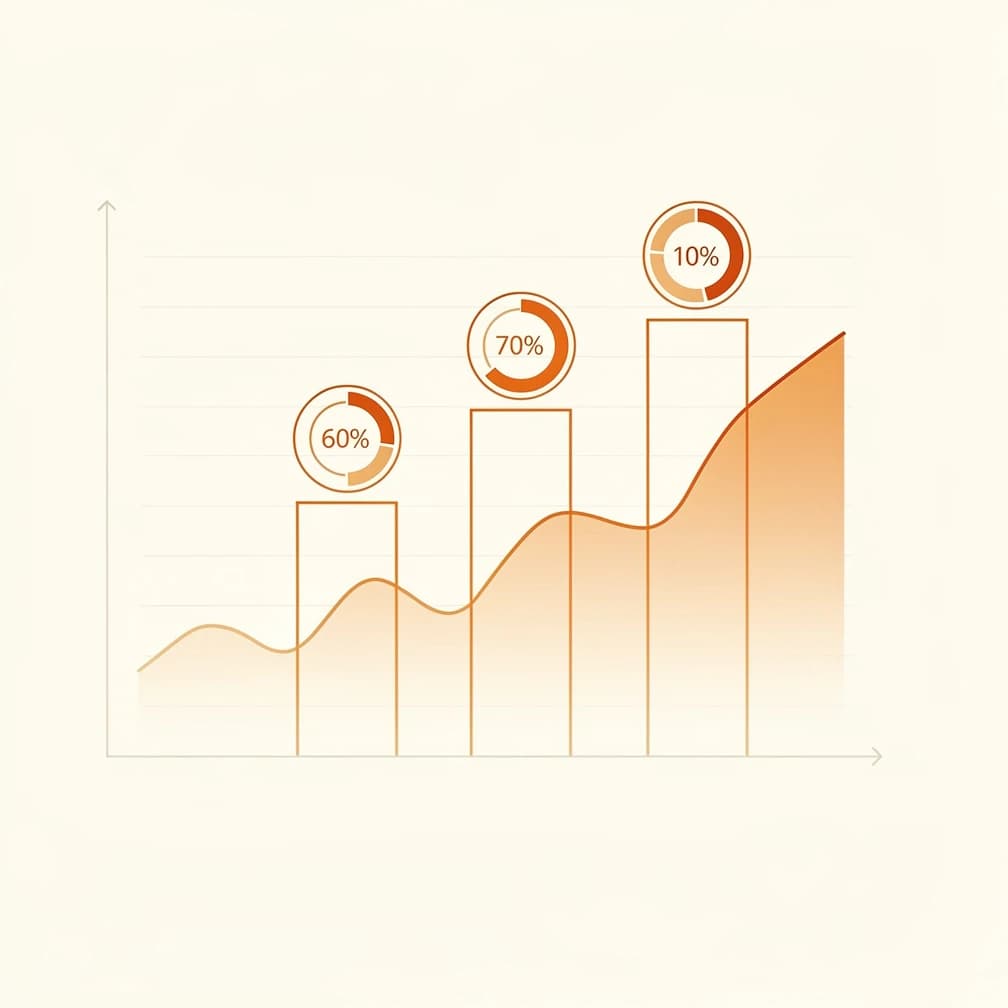
Minimal line art illustration of marketing automation ROI metrics with ascending bar charts and percentage indicators
The ROI framework below provides a template for calculating returns across the three categories. Fill in your own numbers each quarter to track whether the platform is delivering value.
| ROI Category | Metric | How to Measure | Typical SMB Result |
|---|---|---|---|
| Time saved | Hours per week returned | Before/after time tracking per task | 4 to 8 hours/week |
| Cost avoided | Equivalent hiring avoided | Compare output to manual labour cost | $30k to $50k/year |
| Revenue influenced | Leads and conversions from automation | Campaign attribution tracking | 15 to 30% lift in leads |
Review these metrics monthly for the first quarter, then quarterly thereafter. Use the data to decide where to expand automation and where to pull back. If your welcome sequence is driving strong conversions, add a similar sequence for a different audience. If your re-engagement campaign has a 2 percent open rate, rewrite the content or retire the workflow.
According to McKinsey's 2024 State of AI report, organisations that measure AI and automation ROI systematically are 2.5 times more likely to expand their investment confidently. Without measurement, you are guessing — and guessing is how subscriptions creep up while value stays flat.
If you want a structured approach to measuring returns across all your AI and automation investments, our AI implementation metrics guide covers 12 KPIs specifically designed for small business contexts. For broader business growth measurement, GrowthGear has helped Australian businesses achieve 156 percent average client growth through structured AI and automation implementation — and we measure every engagement against those same ROI frameworks. If you want a structured approach to implementing these strategies, that is exactly what we do at GrowthGear. We help Australian businesses turn marketing automation principles into measurable results, from platform selection through to full implementation and ROI tracking. You can also explore our pricing options or check our FAQ page for common questions about working with us. For deeper sales-funnel automation content, visit Sales Mastery on our sales subdomain, or explore AI Insights for technical AI strategy articles.
Sources & References
- Salesforce — "High-performing marketing teams are 2.3x more likely to use marketing automation extensively" (2025)
- McKinsey — "Companies that excel at personalisation generate 40% more revenue from those activities than average competitors" (2024)
- Forrester — "Marketing automation users see 14.5% increase in sales productivity and 12.2% reduction in marketing overhead" (2025)
- Gartner — "67% of marketing automation implementations fail to meet expectations; over-complexity is the leading cause" (2025)
- HubSpot Research — "Automated welcome emails generate 4x open rate and 5x click rate; 82% of marketers cite tool integration as top challenge" (2024)
- Content Marketing Institute — "Marketers who A/B test email subject lines see open rates 11% higher on average" (2025)
- Deloitte Access Economics — "Australian SMBs that phased automation rollout were 3.1x more likely to report sustained adoption after 12 months" (2025)
- Nucleus Research — "Marketing automation delivers an average ROI of $5.44 for every dollar spent" (2024)
- Seek — "Marketing coordinator salary ranges in Australian metro markets: $65,000 to $85,000 per year" (2026)
- Venture Harbour — "Annual benchmark comparison of 23 marketing automation platforms" (2026)