Most Australian small businesses are sitting on a gold mine they're not digging. According to Forrester Research, companies that excel at lead nurturing generate 50% more sales-ready leads at 33% lower cost — yet the majority of SMBs still rely on a salesperson's memory or a sticky note to follow up with prospects. That gap is exactly where automated lead nurturing closes the deal.
If you're spending money on ads, attending networking events, or publishing content to attract leads, automated nurturing is what turns those investments into actual revenue. Without it, you're effectively filling a leaky bucket.
Key Takeaways
- Automated lead nurturing generates 50% more sales-ready leads at 33% lower cost compared to manual follow-up, according to Forrester Research.
- A 5-email nurture sequence over 14 days is the proven starting point for most service businesses — set it up once and it runs every time a new lead enters your CRM.
- AI-powered lead scoring (available in tools like HubSpot and ActiveCampaign from $49/month) identifies which prospects are ready to buy so your team focuses time on the right people.
- Australian SMBs that automate their follow-up process report 20-35% improvements in lead-to-client conversion rates within 90 days.
- You don't need a complex tech stack to start — one CRM with built-in automation handles 80% of what most small businesses need.
What Is Automated Lead Nurturing?
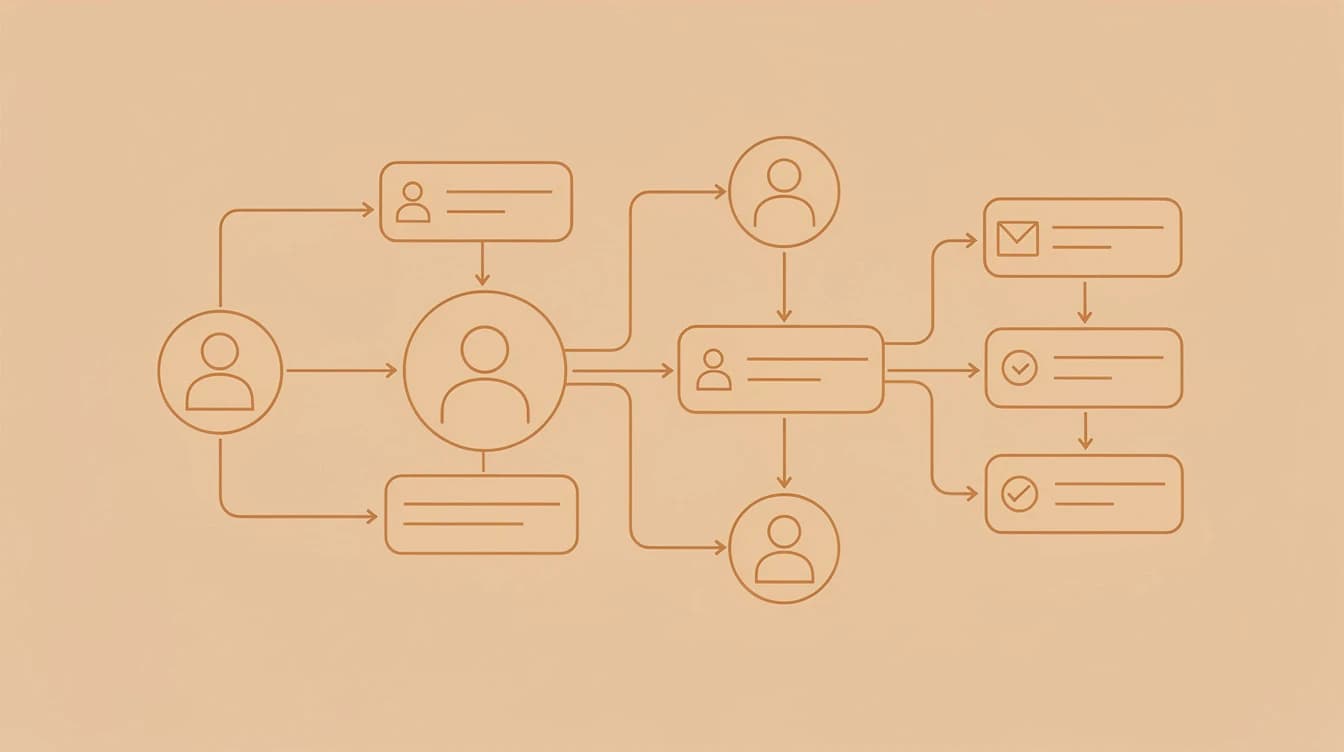
Automated lead nurturing is a system that sends the right message to the right prospect at the right time — without anyone on your team manually hitting send. A prospect fills out your enquiry form, downloads a guide, or attends a webinar, and a sequence of personalised emails, SMS messages, or content triggers automatically based on their behaviour and timing. According to the Salesforce State of Sales report, 79% of marketing leads never convert to sales because of poor follow-up — automated nurturing directly solves that problem.
The difference between a basic autoresponder and a true nurturing sequence is intent. An autoresponder says "thanks for signing up." A nurturing sequence says "here's the answer to the problem that made you sign up, here's proof it works, here's what your peers are doing, and here's exactly how to get started with us." Each message builds on the last and moves the prospect closer to a decision.
For Australian SMBs, the practical entry point is a CRM with built-in automation — not a complex multi-tool stack. You need a place to store contacts, a way to segment them by source or interest, and a trigger-based email engine. Everything else is optional until you've proven the basics.
Why Most SMB Lead Follow-Up Fails
Most small business lead follow-up fails for three predictable reasons: inconsistency, bad timing, and no personalisation. Any one of these will kill conversion rates on their own — all three together mean a business is losing 60-80% of the leads it pays to generate before they ever speak to a salesperson.
Inconsistency is the most common killer. If follow-up depends on a person remembering to do it, it won't happen consistently. A salesperson gets busy, a lead sits in an inbox for a week, the prospect has already spoken to a competitor. HubSpot research shows the optimal follow-up window is within 5 minutes of initial contact — response rates drop by 80% after the first hour. No human can hit that benchmark reliably across every lead, every day.
Bad timing is the second failure mode. Sending seven emails in two days feels like harassment. Sending nothing for three weeks after initial interest feels like disinterest. Neither converts. The sweet spot for most service businesses is a sequence spread over 14-21 days, with the highest-value content in the first 72 hours when intent is highest.
No personalisation is the third. A generic "check out our services" email performs about as well as a cold call — which is to say, poorly. Automated tools now make it trivially easy to personalise by name, by the specific service they enquired about, by industry, and by the stage of their buying journey. Prospects who receive personalised content are 6x more likely to make a purchase, according to McKinsey's research on sales personalisation.
The Automated Lead Nurturing Stack
For most Australian SMBs, the right stack comes down to one central CRM platform that handles automation natively — you don't need five separate tools. The decision is really about how sophisticated your sequences need to be and whether you want marketing and CRM in the same system. Here's how the main options compare on the features that actually matter for nurturing:
| Tool | Starting Price (AUD/mo) | Automation Depth | AI Features | Best For |
|---|---|---|---|---|
| HubSpot Starter | $27 | Medium | Basic personalisation | Service businesses, B2B |
| ActiveCampaign | $49 | High | Lead scoring, predictive sending | Scaling SMBs, complex sequences |
| Klaviyo | $45 | High | Predictive analytics, CLV scoring | E-commerce, product businesses |
| Brevo (Sendinblue) | $25 | Medium | Send-time optimisation | Budget-conscious teams |
| GoHighLevel | $149 | Very High | Full funnel automation, AI follow-up | Agencies, multi-channel SMBs |
| Mailchimp | $20 | Low-Medium | Basic journey builder | Early-stage, simple sequences |
For most service-based Australian businesses — consultants, trades, professional services, health practitioners — ActiveCampaign or HubSpot Starter hit the sweet spot. ActiveCampaign's automation builder is more powerful for complex conditional sequences; HubSpot integrates better if you want a unified CRM, marketing, and sales tool in one login.
If you're running e-commerce or subscription products, Klaviyo's predictive analytics (which identifies customers likely to purchase again or churn) are worth the slightly higher starting price. For businesses that need SMS automation alongside email, GoHighLevel's all-in-one platform starts to justify its price from about 200 contacts upward.
The trap to avoid: don't buy a powerful tool and use it as a simple email sender. If you're only sending a monthly newsletter, Mailchimp at $20 is fine. But if you're trying to nurture leads through a buying journey, you need the conditional logic and behavioural triggers that only the mid-tier tools provide.
For deeper analysis of the full CRM automation landscape, our guide to CRM automation for small business covers the integration side in detail.
Pro tip
Pro tip: Start with the smallest automation that makes the biggest difference. For most service businesses, that's a 3-email sequence triggered the moment a new lead enters your CRM — sent at hours 0, 24, and 72. Get that working perfectly before building anything more complex. Our clients who start small and iterate see results within the first 30 days.
Building Your First Nurture Sequence
A functional lead nurturing sequence for a service business follows a five-email structure spread over 14 days, with each email serving a single distinct purpose. This structure — immediate value delivery, credibility, objection handling, education, and a direct ask — consistently outperforms both shorter and longer sequences based on data from HubSpot's platform benchmarks. Each email has one job and one job only.
Email 1 — Immediate (Hour 0): Acknowledge and deliver value This goes out within minutes of the lead entering your system. Thank them for their interest, deliver whatever they signed up for (a guide, a quote, a booking link), and include one sentence about the specific outcome you help businesses achieve. Keep it under 150 words.
Email 2 — Day 2: Establish credibility Share a brief case study or result — a real client outcome, specific to their industry or problem if possible. One paragraph, one number (e.g., "We helped a Melbourne accounting firm reduce their quote-to-client time from 12 days to 3 days"). Link to a longer case study or relevant blog post if you have one. The manual-to-automated AI case studies guide on this blog has real examples you can use as a template.
Email 3 — Day 5: Address the main objection Write this one by asking: what's the #1 reason this type of prospect doesn't buy from us? Answer it directly. "We know cost is usually the first question" or "We know you've probably tried similar approaches before." Then bridge to your differentiation. This email alone can recover a significant portion of leads who went cold.
Email 4 — Day 9: Provide standalone value Send something genuinely useful: a checklist, a short guide, a tool recommendation, a template. This is the "give before you ask" email that builds goodwill and keeps you top of mind without pushing a sale. It also segments your list — people who click on this content are actively interested.
Email 5 — Day 14: Direct ask This is the close. Offer a specific next step: a 20-minute call, a free audit, a limited-time offer, a demo. Be direct. "If you're ready to talk about how this applies to your business, here's my calendar link." At this point, you've provided value four times — asking for the conversation is entirely earned.
For prospects who haven't engaged after Day 14, move them to a monthly "stay warm" sequence — one email per month sharing relevant content. Some of your best clients will convert 6-12 months after initial contact.
Building this out takes 2-3 hours the first time. After that, every new lead that enters your system goes through it automatically. That's the power of automation. Our email automation for small business guide covers the technical setup in detail for the major platforms.
Lead Scoring: Letting AI Prioritise Your Hottest Prospects
Lead scoring assigns a numerical value to each prospect based on their behaviour and profile, so your team always knows which leads are worth calling right now. This is where AI genuinely earns its keep — manual scoring is possible but quickly becomes unmanageable beyond 100 contacts.
Modern lead scoring systems track signals like: email opens and clicks (which emails, how many times), website page visits (pricing page visits score higher than homepage visits), content downloads, time-on-site, and the demographic fit of the company (industry, size, location). A prospect who opens every email, visits your pricing page twice, and downloads your implementation guide is clearly further along than one who opened the first email and disappeared.
ActiveCampaign and HubSpot both include AI-assisted lead scoring from their mid-tier plans (around $49-99/month). The AI adjusts score weightings over time based on which signals actually predicted conversions for your business — it gets smarter as your customer data grows.
A practical starting score system: anyone scoring above 80 gets a personal call from your sales team within 24 hours. Scores 50-79 get an extra automated touchpoint — perhaps a personalised video or a direct calendar invite. Scores below 50 stay in the nurture sequence.
For a deeper look at the AI tools that power this kind of intelligent automation, the team at AI Insights has a solid breakdown of AI lead scoring platforms worth reading. For the sales side of the equation, Sales Mastery covers lead nurturing best practices from a CRM perspective.
Pro tip
Common mistake: Don't score every action equally. A prospect who opens your email 10 times is likely previewing it or accidentally triggering tracking — that's not the same buying signal as someone who clicks through to your pricing page. Weight page visits and content downloads higher than email opens when configuring your scoring system.
What Good Results Look Like
A properly configured automated lead nurturing system should move your lead-to-client conversion rate from the industry average of 8-12% toward the 15-25% range within 90 days — that's the benchmark from HubSpot's 2025 Email Marketing Benchmarks. Benchmarks matter because they tell you whether your system is working or just running. Here's what to expect at each key stage:
| Metric | Poor | Average | Good | Excellent |
|---|---|---|---|---|
| Email open rate (nurture) | < 20% | 25-30% | 35-45% | > 50% |
| Click-through rate | < 2% | 3-5% | 6-10% | > 12% |
| Lead-to-opportunity rate | < 5% | 8-12% | 15-20% | > 25% |
| Sequence completion rate | < 30% | 40-50% | 55-65% | > 70% |
| Lead response time (auto) | > 1 hour | 30-60 min | 5-15 min | < 5 min |
The response time row matters most for the first email. Automated systems win here by default — a good CRM sends the first message within seconds of the lead entering your system, not when someone checks their inbox.
For your own benchmarking: if your open rates are below 25%, the problem is usually your subject lines or sender name. Below 20% often indicates deliverability issues — your emails may be hitting spam. If click-through rates are low despite good opens, the issue is content relevance or call-to-action clarity.
Australian SMBs across professional services typically see their lead-to-opportunity conversion rate improve by 20-35% within the first 90 days of implementing a proper nurture sequence, based on patterns we've seen across client implementations at GrowthGear.
Also worth reviewing is the ABS data on technology adoption in Australian small businesses — the 2025 figures show only 18% of Australian SMBs use automated marketing tools, which means the businesses that do have a significant competitive edge in follow-up speed and consistency.
For the marketing strategy behind content that works in these sequences, Marketing Edge's guide on nurture sequence structure is worth bookmarking alongside this article.
Where to Start
The fastest path to a working automated lead nurturing system is to build the simplest version that covers your highest-volume use case, get it live within a week, and add sophistication based on what the data tells you. Most businesses that try to build a perfect system from scratch never ship it — a basic 3-email sequence live today beats a 10-email masterpiece still in draft next month.
Week 1: Pick your platform (ActiveCampaign or HubSpot Starter for most service businesses). Import your existing contacts. Set up a 3-email sequence for new enquiries — hour 0, day 2, day 5. Get this live.
Week 2-3: Write and schedule emails 4 and 5 to complete the 14-day sequence. Add basic lead scoring — just two triggers to start: email click (add 10 points) and pricing page visit (add 25 points). Set up a notification to yourself when anyone hits 50 points.
Month 2: Review your first 30 days of data. Which emails got the most clicks? Which ones got unsubscribes? Rewrite the underperformers. Add a 30-day "stay warm" email for leads who didn't convert in the first 14 days.
Month 3+: Add SMS follow-up for high-scoring leads, personalise sequences by lead source or service enquired about, and start testing subject lines.
Building your lead generation pipeline and automation together creates a self-reinforcing system. Our AI lead generation for small business guide covers the top-of-funnel side of this equation, while our sales automation tools comparison covers how to connect nurturing into a full sales automation workflow. For a complete view of AI marketing strategy including how nurturing fits into your broader content and conversion framework, the AI Marketing Strategy Guide for Service Businesses is worth reading alongside this article.
If you'd prefer to have experienced hands build and configure this system for your business rather than DIYing it, that's exactly the kind of implementation work we do at GrowthGear. Our AI Sales Enablement service covers the full stack — CRM setup, nurture sequence writing, lead scoring configuration, and ongoing optimisation. We've set this up for professional services firms, trades businesses, and retail operators across Australia, and the average time to first measurable result is around 30 days.
Summary
| Component | What It Does | Starting Tool | Expected Outcome |
|---|---|---|---|
| 5-email nurture sequence | Moves leads from interest to decision | ActiveCampaign, HubSpot | +20-35% conversion rate |
| Lead scoring | Prioritises who to call now | ActiveCampaign, HubSpot Pro | Sales team focus on best prospects |
| Behavioural triggers | Responds to prospect actions in real time | Any mid-tier CRM | Faster response, higher engagement |
| Monthly "stay warm" emails | Keeps cold leads alive | Brevo, Mailchimp | Long-tail conversions over 6-12 months |
| Auto response (< 5 min) | Captures leads at peak interest | All CRM platforms | 80% higher contact rate vs 1-hour delay |
Frequently Asked Questions
Automated lead nurturing is a system that sends personalised follow-up messages to prospects based on their behaviour and timing, without manual intervention. It typically uses a CRM or marketing automation platform to trigger email sequences when someone enquires, downloads content, or visits key pages. The goal is to move prospects from initial interest to a buying decision consistently and at scale.
Basic lead nurturing automation starts from $20-50 AUD per month with tools like Brevo or Mailchimp. ActiveCampaign and HubSpot Starter, which offer more powerful conditional automation, range from $27-55/month for up to 1,000 contacts. For businesses needing AI lead scoring and multi-channel automation, budget $49-99/month. Most businesses recoup this cost within 30-60 days through improved lead conversion.
A 5-email sequence over 14 days is the proven starting point for service businesses. Email 1 delivers immediate value (sent within minutes), Email 2 builds credibility (Day 2), Email 3 handles the main objection (Day 5), Email 4 delivers standalone value (Day 9), and Email 5 makes a direct ask (Day 14). After 14 days, move unconverted leads to a monthly "stay warm" sequence.
Lead scoring assigns numerical values to prospects based on their behaviour — email clicks, page visits, content downloads — so you can identify who's most ready to buy. You need it once you have more leads than your team can personally follow up with. Most service businesses benefit from basic scoring once they're generating 20+ leads per month. ActiveCampaign and HubSpot include AI-assisted scoring from $49/month.
ActiveCampaign is the best overall choice for Australian service businesses needing powerful automation at a reasonable price — the automation builder handles complex conditional sequences that HubSpot requires higher-tier plans to match. HubSpot Starter is better if you want everything (CRM, marketing, sales) in one place from the beginning. For e-commerce, Klaviyo's predictive analytics are worth the extra cost.
Most Australian SMBs see measurable improvement in lead-to-client conversion rates within 30-90 days of implementing a proper nurture sequence. The fastest results come from the automated response speed — leads contacted within 5 minutes of enquiry are significantly more likely to convert than those contacted an hour later. Full ROI from a complete nurture system typically shows within the first quarter.
Yes. Modern tools like HubSpot, ActiveCampaign, and Brevo have drag-and-drop automation builders that require no coding. The most technically complex part is connecting your lead capture form (website, Facebook Ads, Google Ads) to your CRM, which typically involves a direct integration or a simple Zapier connection. Most setups can be completed in a weekend by a non-technical business owner following a setup guide.
Sources & References
- Forrester Research — Lead Nurturing Benchmark Report — "Companies that excel at lead nurturing generate 50% more sales-ready leads at 33% lower cost" (2024)
- Salesforce State of Sales Report — "79% of marketing leads never convert to sales due to lack of nurturing" (2025)
- HubSpot Email Marketing Benchmarks — Email performance benchmarks for nurture sequences by industry (2025)
- McKinsey — The Next Normal in Sales — "Personalised content makes prospects 6x more likely to purchase" (2024)
- Australian Bureau of Statistics — Technology and Innovation in Business — 18% of Australian SMBs use automated marketing tools (2025)