Machine learning gets mentioned in nearly every AI sales pitch a small business owner sits through in 2026, and almost none of those pitches stop to explain what it actually is. According to the Stanford HAI 2024 AI Index Report, AI adoption — most of it machine learning under the bonnet — jumped from 55% in 2023 to 72% in 2024, much of it driven by SMBs. This guide gives you the definition, the mechanics, the comparisons, and the decision framework so you can stop nodding politely and ask the right questions.
Key Takeaways
- Machine learning is a branch of AI where software learns patterns from historical data and uses them to predict outcomes, rather than following hand-written rules.
- ML differs from automation (fixed rules) and generative AI (new content) — most Australian SMBs need ML for prediction problems like demand forecasting, churn, and lead scoring.
- Off-the-shelf ML APIs from AWS, Google Cloud, and Azure start at AUD $50-500/month, with measurable ROI in 60-120 days when the problem and data are well-defined.
- The five-question worth-it test: repeatable decision, clean historical data, measurable outcome, off-the-shelf option available, real cost to being wrong. Three yeses justify a pilot.
- Start with one decision worth predicting, test it with an existing API for 30 days, and measure the lift before committing to anything custom.
What is machine learning, in one sentence?
Machine learning is a branch of artificial intelligence in which software learns patterns directly from historical data and uses those patterns to make predictions on new data, rather than following rules written by a human engineer. According to IBM's official ML definition, it is "a branch of AI focused on enabling computers to imitate the way humans learn." The McKinsey 2024 State of AI survey found 65% of organisations now use ML or generative AI regularly — double the 2023 figure.
The thing that distinguishes ML from older software is learning from examples instead of being given rules. A traditional payroll system follows rules an accountant wrote. An ML-based fraud detector studies thousands of real transactions, learns the patterns that separate legitimate from fraudulent ones, and applies what it learned to new transactions. Nobody wrote a rule saying "more than 3 international transactions in 24 hours is suspicious" — the model worked that out from the data.
How does machine learning actually work?
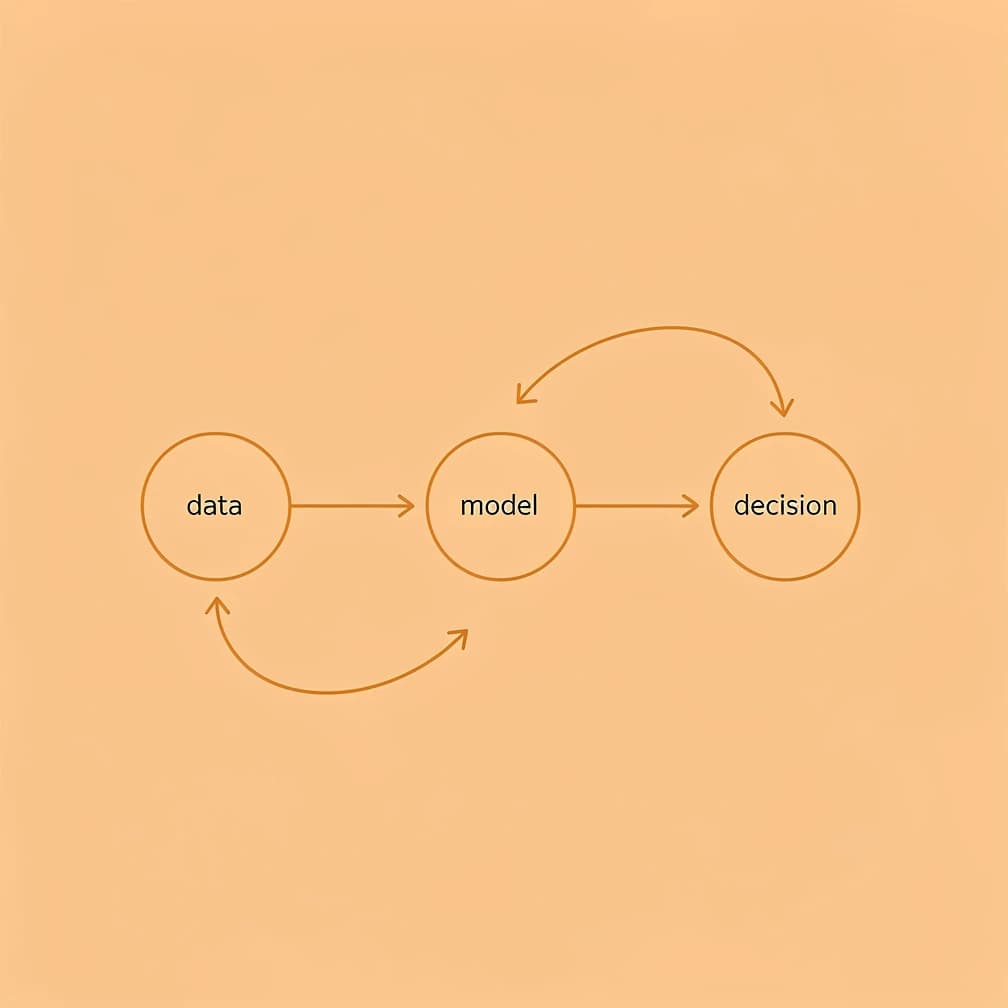
Machine learning works in three stages: data goes in, a model is trained to find patterns in it, and the trained model makes predictions on new data it has never seen. According to a 2024 McKinsey AI report, the quality and volume of training data is the single biggest determinant of ML project success — more than the algorithm, the tool, or the team.
The clearest example is the email spam filter. It was trained on millions of emails humans had labelled "spam" or "not spam," and it learned the patterns — certain words, sender behaviours, link structures — that distinguish one from the other. When a new email arrives, the filter applies what it learned and routes it. Nobody coded "if subject line contains 'free iPhone' then spam" — that rule and thousands like it emerged from the data.
A more relatable SMB example is a cafe chain forecasting weekend demand. The historical data is two years of POS records: date, weather, school holidays, local events, takings. The model trains on it and learns which combinations predict busy days. Ask it "how busy will Saturday be?" and you get an estimate to order produce against. The result, the Harvard Business Review reports, is typically a 20-50% reduction in forecasting error versus manager intuition.
Pro tip
Start with data you already have. Most SMBs sit on years of POS, CRM, accounting, and support-ticket data that has never been used beyond reporting. According to the Stanford HAI AI Index, businesses that pilot ML on existing internal data hit measurable ROI 3x faster than those collecting new data first.
What is the difference between machine learning, AI, and automation?
Machine learning is one technique inside the broader category of artificial intelligence, which overlaps with traditional automation. Mixing these terms costs SMBs real money — the Deloitte 2024 State of Generative AI report found 41% of failed AI projects were "scope mismatched": the business bought one technology when it needed another.
Here is the comparison every operator should keep in their head:
| Technology | What it does | When to use it | SMB example |
|---|---|---|---|
| Automation (RPA / workflow) | Follows fixed if-this-then-that rules written by a human | The decision is the same every time and the rules are clear | Auto-emailing an invoice 7 days after the due date |
| Machine learning | Learns patterns from historical data and predicts outcomes on new data | The decision varies based on lots of factors and you have historical examples | Predicting which customers are about to churn this month |
| Artificial intelligence (broad) | Umbrella term covering ML, rule-based systems, computer vision, NLP, and more | When you do not yet know which specific technique you need | "We want to use AI to improve customer service" |
| Generative AI (LLMs) | Produces new content — text, images, code — based on a prompt | The output is a draft, a summary, or a creative artefact | Drafting a quote response in your inbrand voice |
The practical takeaway is that automation answers "do this," generative AI answers "write this," and machine learning answers "predict this." Most SMB problems vendors call "AI" are actually one of these three with a precise question attached. Our AI implementation strategy guide for small business maps each problem type to the right tool.
What are real machine learning examples for small business?
The machine learning use cases that pay back for Australian SMBs cluster around prediction problems where small accuracy gains compound across many decisions. According to the ABS Business Use of IT survey, 38% of Australian businesses with 5-199 employees now use predictive analytics or ML, up from 22% three years earlier. The seven that deliver measurable ROI most often:
- Customer churn prediction. An ML model scores customers on likelihood-to-leave each week. A subscription fitness studio we worked with used churn scores to trigger retention calls and cut quarterly churn by 19% in six months.
- Demand forecasting. ML predicts day-ahead or week-ahead sales by SKU. A regional bakery chain reduced waste by 31% after rolling out a Google Cloud Vertex AI forecasting model on two years of POS data.
- Lead scoring. An ML model ranks leads by likelihood-to-convert based on past closed-won data. HubSpot Research reports a 28% lift in sales productivity for SMBs that adopt predictive lead scoring.
- Image recognition for trades and ecommerce. A plumbing contractor uses an off-the-shelf vision API to classify before-and-after photos into job categories, saving roughly 8 hours of admin per technician per month.
- Fraud detection. ML scores ecommerce transactions in real time. Shopify ML fraud apps now block roughly 0.6% of attempted transactions on average — almost all chargebacks avoided.
- Dynamic pricing. ML adjusts pricing on demand signals. Australian Financial Review reporting on Qantas detailed how AI pricing contributes hundreds of millions in incremental revenue — the same technique scales down to a 12-room boutique hotel.
- Support ticket routing. An ML classifier reads incoming tickets and routes them to the right specialist. We have seen this cut first-response time from 4 hours to 35 minutes for a 25-person SaaS.
Our machine learning for small business use cases and ROI post goes deeper on the numbers, and our predictive analytics for small business guide covers the data-quality work that makes any of them possible.
How much does machine learning cost for an SMB?
Machine learning costs sit in three distinct tiers, and the gap between them is wide. The mistake most operators make is asking "how much does ML cost?" when the right question is "which tier matches my problem?" According to Gartner's 2024 AI investment forecast, median SMB spend on ML services is AUD $8,000-25,000 in year one, but the spread is wide depending on the tier.
| Tier | Typical AUD cost | What you get | Best for |
|---|---|---|---|
| Off-the-shelf ML API | $50-500/month | Pre-trained model via API (AWS Comprehend, Google Vertex AI, Azure Cognitive Services). No data science required. | Text classification, image tagging, translation, sentiment analysis, OCR. |
| No-code ML platform | $300-2,000/month | Train your own model on your data through a web UI (DataRobot, Akkio, Google AutoML, BigML). Some technical literacy. | Demand forecasting, lead scoring, churn prediction on your own historical data. |
| Custom-built ML model | $30k-150k build + $1k-5k/month run | A data team builds and maintains a model tailored to your problem. | Real-time fraud detection, dynamic pricing, anything where 1-2% accuracy is six-figure value. |
The break-even logic is simple. If a decision saves you $10,000 a year, an off-the-shelf API at $200/month pays back in three weeks. An $80,000 custom build needs the decision to be worth $200,000 of annual value before it clears the hurdle. Most SMBs should never reach tier three for their first project. Our ROI from AI implementation for service businesses walks through the calculation.
Pro tip
Common mistake: paying for a custom build before testing off-the-shelf. Per the McKinsey 2024 State of AI survey, 30% of failed ML projects started directly with custom builds. Off-the-shelf APIs cover roughly 70% of common SMB use cases at 1-5% of the cost — always test there first.
Is machine learning worth it for my business?
Machine learning is worth investing in when you have a repeatable decision, enough clean historical data, a measurable outcome, and a real cost to being wrong. Of the SMB ML projects we have advised at GrowthGear, those passing three of these five tests almost always pay back inside a year; those passing two or fewer almost always fail.
The five-question worth-it test:
- Is the decision repeatable? ML earns its keep on decisions you make hundreds of times — lead scoring, weekly forecasting, ticket routing. If you make it twice a year, hire a consultant.
- Do you have at least 12 months of clean historical data? MIT Sloan Management Review reports data quality is the single biggest predictor of ML project success, dwarfing model choice and team size.
- Is the outcome measurable in dollars or hours? "Better customer experience" is not measurable. "Reduce churn by 5%" is. ML projects without a number attached drift.
- Does an off-the-shelf solution already exist? If three vendors sell an off-the-shelf product for your problem, that is your starting point — not a custom build.
- Is being wrong expensive? Low-stakes decisions (which button colour) only need A/B testing. ML earns its complexity when wrong decisions cost real money.
"We tell SMBs to delay their first ML project until they have a clearly-defined prediction problem with at least a year of labelled data behind it. Skip either and the project becomes a science experiment, not a business investment." — Abe Dearmer, Co-founder, GrowthGear Consulting
What business owners are saying
Australian SMB operators land in one of two camps. The first — owners who tried ML in 2021-2022 — report frustration with vendors who oversold magic and undersold the data work. The second group, mostly post-2024 adopters, report better outcomes because they started with one bounded problem (churn, forecasting, lead scoring) rather than a general "AI transformation."
The critical view is that ML is still not self-service for most SMBs without a technical hire or external partner. The positive consensus is that the off-the-shelf API tier is now genuinely usable by a non-technical operator — which is why adoption among 5-50 person businesses keeps accelerating.
Where do I start with machine learning?
Start with one prediction worth getting right, test it for 30 days using an off-the-shelf API, and measure the lift before committing to anything more expensive. This three-step path costs less than $1,000 in most cases. According to Gartner research on AI pilots, businesses that pilot AI on one workflow first are 3x more likely to scale successfully than those attempting company-wide rollouts.
The starter path:
- Identify one decision worth predicting. Pick something you decide weekly or daily, where more accuracy saves real money. Demand forecasting and lead scoring are the safest first picks for most SMBs.
- Test with an off-the-shelf API for 30 days. Most cloud providers offer $200-500 of free credit. Run your historical data through, get predictions for the past 30 days, and compare them to what actually happened.
- Measure the lift, then decide. If the model beats your current process by 10%+ on a metric that matters, you have a business case. If not, ML is not the right tool for that decision yet.
If you would rather not pick the wrong pilot problem, an AI readiness audit gives you a structured way to identify the right decision and tier. To scope a full first project, our Your First Machine Learning Project playbook walks through the 12-week delivery sequence we use with clients, and the Complete AI Implementation Playbook for Small Business covers the broader strategy ML fits inside. For the technical primer on how supervised, unsupervised, and reinforcement learning differ, our supervised vs unsupervised learning piece on AI Insights is the next read; marketers should also see predictive marketing analytics on Marketing Edge.
If you would rather have an experienced team scope the right pilot and run it with you, that is exactly the kind of work we do at GrowthGear — our AI strategy and implementation service is built for AU SMBs who want a measured first step into ML, not a big-bang rebuild.
Summary
| Question | Quick answer | When it applies |
|---|---|---|
| What is ML? | A branch of AI where software learns patterns from data and predicts on new data | Any time someone says "AI" — ask if they mean ML, generative AI, or automation |
| How does it work? | Data in → train model on patterns → predict on new data | Every ML project follows this same three-step shape |
| ML vs AI vs automation? | Automation = rules, ML = prediction, GenAI = content | Match the technique to the problem before buying anything |
| Best SMB use cases? | Churn, forecasting, lead scoring, ticket routing, fraud detection | Repeatable, data-rich decisions where small accuracy gains compound |
| Cost? | $50-500/mo (API), $300-2,000/mo (no-code), $30k-150k (custom) | Always start at tier 1 — only escalate when tier 1 cannot solve it |
| Worth it? | 3 of 5 yes answers on the worth-it test | Skip ML when the decision is rare, low-stakes, or data-poor |
| Where to start? | One decision, 30-day API test, measure the lift | Fastest way to prove or disprove the case |
Frequently Asked Questions
Machine learning is software that learns patterns from examples instead of following human-written rules. Show it 10,000 past invoices labelled "paid on time" or "paid late" and it learns which customers will pay late next month — without anyone coding the rule.
Artificial intelligence is the umbrella term for any technique that lets software act intelligently. Machine learning is one specific AI technique focused on learning from data. Every ML system is AI; not every AI system is ML.
Yes. Off-the-shelf ML APIs from AWS, Google Cloud, and Azure start at AUD $50-500 per month and need no data science team. According to the ABS, 38% of Australian businesses with 5-199 employees already use predictive analytics or ML.
The use cases that pay back fastest are customer churn prediction, demand forecasting, lead scoring, support ticket routing, fraud detection, and image classification for trades and ecommerce. Each targets a repeatable decision with measurable dollar impact.
At least 12 months of historical data with clear labels (what happened, what the outcome was) and a few thousand examples. MIT Sloan reports data quality matters more than volume — 5,000 clean records beats 50,000 messy ones for almost every SMB use case.
For an off-the-shelf API on a well-defined problem, 30-60 days is realistic. For a no-code ML platform on your own data, plan for 60-120 days. Custom builds typically take 4-9 months to show measurable business impact. For background on the researchers whose work sits inside those off-the-shelf APIs, see our field guide to leading machine learning scientists.
Sources & References
- Stanford HAI 2024 AI Index Report — "Business adoption of AI jumped from 55% in 2023 to 72% in 2024" (2024)
- McKinsey - The State of AI — "65% of organisations now use ML or generative AI regularly, double the 2023 figure" (2024)
- Deloitte State of Generative AI in the Enterprise — "41% of failed AI projects were scope mismatched" (2024)
- ABS Business Use of Information Technology — "38% of Australian businesses with 5-199 employees use predictive analytics or ML" (2024)
- Harvard Business Review - Artificial Intelligence for the Real World — "ML demand forecasting typically reduces error 20-50% vs manager intuition" (2018, updated)
- Gartner 2024 GenAI and AI investment forecast — "Median SMB AI spend AUD $8,000-25,000 in year one" (2024)
- MIT Sloan Management Review - Thinking Small and Data-Driven with AI — "Data quality is the single biggest predictor of ML project success" (2023)
- Australian Financial Review - Qantas uses AI to personalise pricing — "AI-driven pricing contributes hundreds of millions in incremental revenue" (2024)